 Skip to content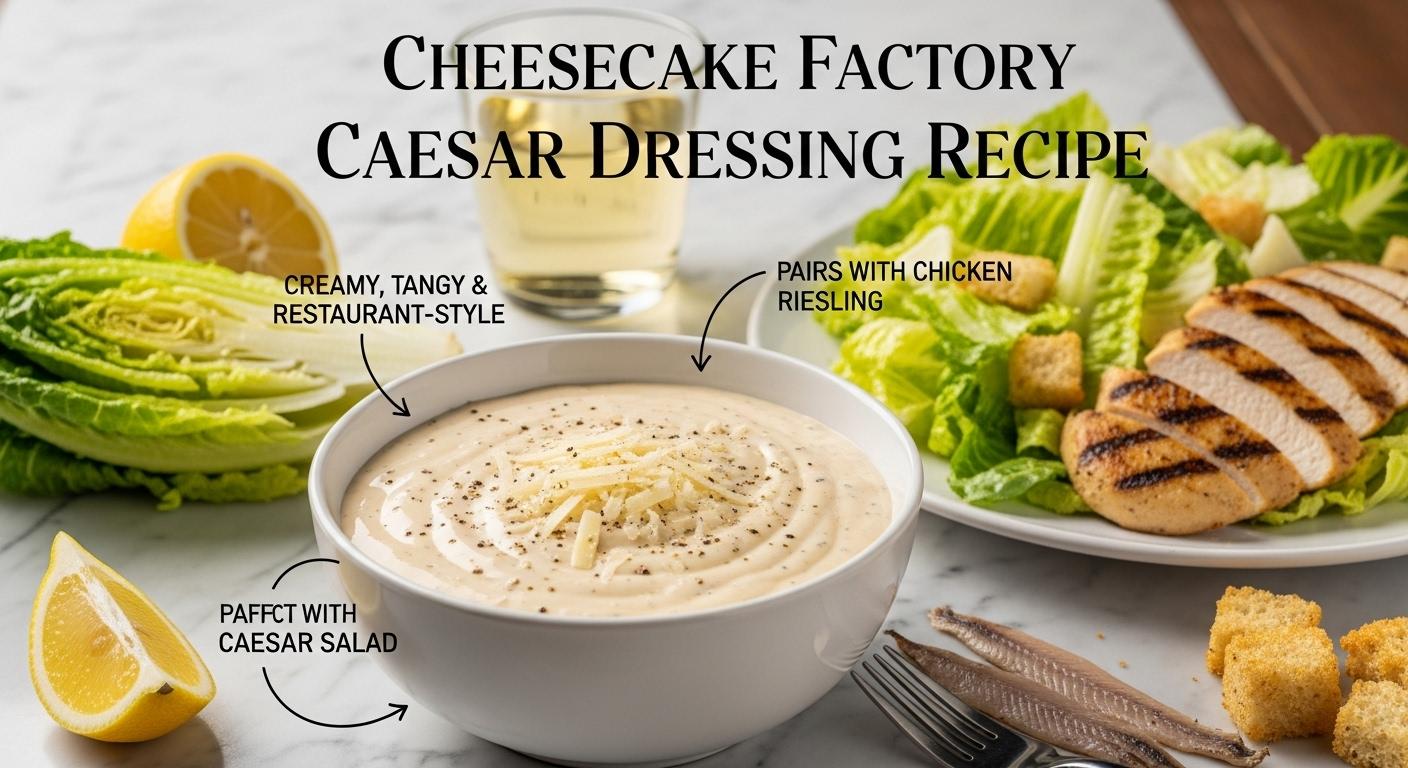
What makes Cheesecake factory Caesar Dressing addictive?

Cheesecake Factory Caesar Dressing Recipe
Inquire ten clients why they continue to order the Cheesecake factory caesar salad and most of them will refer to that same creamy, umami dressing. It hits the golden mean between the standard notes of Caesar (garlic, lemon, Parmesan, anchovy) and the smooth and restaurant body that sticks to cold romaine and hot croutons. The salad is listed on the menu as an Almost Traditional Caesar -croutons, Parmesan, and the house dressing, which lets you know they want to strike that familiar, and have some brand magic in the blend. When you are dining in that tasty, savory profile is meant to be large enough to accommodate up to hearty content–and it does.
The straight-forward fact is that Cheesecake factory has not released a formal dressing formula and therefore, it is through menu description, nutrition facts and a good deal of trial and error that we know anything about the taste. There are several tried and true Caesar recipes that follow the same formula of DNA anchovy (or anchovy paste), garlic, lemon juice, Worcestershire, Dijon, and Parmesan, but are either bound with raw egg yolks (authentic) or a mayonna base (creamy, stable, and ultra-easy at home). When you compare reliable recipes, these ingredients are repeated and that is why a good cheesecake factory caesar dressing recipe is dependent on the same ingredients.
Servings at the restaurant are known to be ample, hence the dressing is adjusted to be vibrant with the very first bite to the final bite. It is not too much lemon to slice through fat, not too much umami to make it salty, and the amount of salt needed so that the Parmesan does not take over. When you are DIY-ing, you can leave that balance the same but turn it to your liking, add more lemon and make it brighter, or less heat and mash the garlic rather than mince it to a fine, which will result on a smoother bite without as much of a harsh bite. This is what makes homemade so good, those little additions.
Ingredients Deep-Dive: Cheesecake Factory Caesar at Home.
We can deconstruct the dressing to its basic drivers. First is umami- anchovies, Parmesan and Worcestershire sauce. The three of them provide richness without tasting fishy, as long as you counter with acid and do not over-salt (the Parmesan adds salt, as well). Second, there is acidity, which is a combination of lemon juice (bright, fresh) into which a faint taste of vinegar may be added to be lifted. Third is body–oil that is emulsified into the body and egg yolk when you want to be strictly classic or a mayo base when you just want things to be easy and stay in the fridge. These pillars are homogenous in reliable Caesar sources, though precise ratios are merely a matter of taste.
Wonder how this fits in with the Cheesecake factory dinner experience? check the facts: nutrition trackers show that the cheesecake factory caesar salad has quite a bit of fat and sodium in it, which is precisely what you would guess a dressing made of Parmesan and oil and wrapped around a large bowl of greens and croutons, would contain. (The portions in the restaurant are also notoriously large.) That is one of the contexts that are used in setting expectations to be made with your own–use good lemon to stay bright and do not stinge on fresh and real Parmigiano-Reggiano to get that restaurant smell and taste.
Regarding the debate of authenticity like the egg and the mayonna, there can be both. Egg yolks are regularly employed in Classic Caesar to emulsify oil into a glossy spoon-coating sauce; many of the contemporary and popular ones use mayonnaise in place to make things easier (and to prevent raw egg). Whichever road you take, you can land on a dressing that will bear clearly the name of Caesar, particularly when you use anchovy (or a quick alternative) and Parm.
Cheesecake factory Caesar Dressing Recipe (Tested).
This one retains the essences of the creamy Caesar of the restaurant but remains easy to make on a weekday. It is daring, spicy and ungenerous–but light enough not to paralyse the romaine. The technique is approximately 10-12 minutes and has the benefit of rewarding you with a jar that lasts you several days. It is built on the time-tested Caesar “matrix” you will find in reputable sources of home cooking information: anchovy/garlic/lemon/Worcestershire/Dijon/Parmesan, and a creamy base with some couple of pro balance checks to finish it.
To those who desire to get fussy about using yolks, it is easy to modify; to those who do not want an egg, this base is ready to go. In any case, the dressing will make the same flavor inclination as one gets when ordering at the restaurant (without portion shock). And since you are the one in charge, you can customize the garlic warmth, saltiness and sharpness so that it comes just the way you like it- something you cannot do at the table.
Cheesecake factory Caesar Salad and The upgrade With Chicken.
The official menu consists of the Cheesecake factory Caesar Salad that is the Almost Traditional Recipe with Croutons, Parmesan Cheese and Our Special Caesar Dressing and you can add chicken to make it a complete meal. That addition makes a large starter a nice entree, and it is among the most commonly used orders people make of a Caesar at any restaurant. It is easy to recreate one of the cheesecake factory caesar salad with chicken at home; romaine, croutons made with garlic, shaved or coarsely grated parmesan, your favorite dressing, and a juicy well-seasoned chicken breast (or some thighs to give more flavor) cut and heaped over the greens.
Nutritionally speaking, the restaurants can be high-calorie due to the heavy pouring of dressing and croutons. The results obtained by third party nutrition databases indicate widely different totals- some of portion based, some of update based, but the same point is invariably that the fat and sodium add up fast. That can be transferred to home preparation as effortlessly as tossing lightly, tasting and adding only what you need. The best kept secret is control.
Lastly, when you are serving a crowd, you think caesar bar. Store at different levels (greens, croutons, cheese, chicken, dressing) so that everyone can make his/her level of dressing. It is an easy method of conciliating light-dressers and heavy-pourers at the same table–and no one has to drown the salad till you are dishing out the main courses.
Beyond the Bowl-Pairings, Ideas of meal, and Chicken Riesling Tie-In.
A great Caesar dressing is not just any salad condiment. It is a spread (epic on a chicken ciabatta sandwich), a dip (crudites or roasted potatoes), a marinade (thinned with lemon and a splash of olive oil on chicken thighs) and a sauce to finish (a drizzle over grilled romaine or next to roasted salmon). A natural companion in the Cheesecake Factory menu is that of Chicken Riesling- sauteed chicken, mushrooms, onions, bacon and garlic in Riesling cream sauce which is frequently served with buttered Parmesan pasta. Should you be setting up a home-based restaurant-like dinner, the creamy, winey entrée and the bright-pink Caesar starter is an archetypical high-low combination: the rich main, the crunchy salad.
You are aware that this combo is effective when you have ordered it in house. The crispness and juiciness of Caesar also cleanse your mouth between the creamy pasta and spicy chicken; and the slight sweetness and acidity of the Riesling also resonate with the lemon in the dressing without being over-competitive. The cloned versions of Chicken Riesling have long been a tradition of home cooks (Riesling + cream + mushrooms + alliums + a porky touch such as bacon or pancetta) and run that variation on the play on a special occasion.
In the case of weeknights, you will achieve 80% of the pleasure with one-fifth of the exertion: you can use a spoon or two of Caesar dressing and a squeeze of lemon to toss warm rotisseries of chicken chunks, and then pile them on top of the romaine, croutons and shaved Parm. Dinner, done.
Troubleshooting & FAQs
You can always tell that small touches can make the difference when you have had a Caesar that was too garlicky, or too thick. The good news: there is a solution to all the usual hiccups–the majority are quick. Over-salted? Add acid and fat. Too thin? Emulsify or chill. Lacking oomph? Amp umami and salt–but gently. And should you split the emulsion, there is nothing to rush about: you can revive it with a new foundation, and by taking your time to whisk it. The more you tinker and fiddle the more you’ll create that internal “click” when everything is in the right configuration.
Food-safety is also typical. In case you opt to use raw egg yolks in an attempt to have an authentic dressing, then adhere to good handling procedures and think of using pasteurized eggs to minimize the risk involved. The FDA particularly recommends that raw and lightly cooked eggs should not be used as homemade dressings to the at-risk groups; Pasteurized eggs and commercially prepared dressings are safe substitutes. The dressings made out of mayonna (raw yolks omitted) are a simple worry-free way of most households.
Vegan or anchovy-free? You can totally replicate the umami of capers and a little dose of soy or vegan Worcestershire but purists will insist that it is the anchovy that is the magic. You will still end up with a fantastic dressing with it, just make sure that you have your lemon and your Parm (or a vegan hard cheese version) stand out so that it says clearly, Caesar.
Taste and Compared to Traditional Caesar.
A typical Caesar dressing is an anchovy-based (with a hint of umami), Parmesan and Worcestershire-filled middle, lemon the trumpet-cutting-through-it, and garlic the unmistakable smell, which informs your mind that Caesar is coming. The take at the Cheesecake factory is leaning into the same architecture, though in a manner that brings out a particularly creamy and clingy feel, or, to put it in other terms, rather restaurant-style velour instead of a brisk vinaigrette. When you have ever whipped a traditional yolk-and-oil dressing and compared it to a mayo one, you have had the difference: mayo versions are already stabilized and are less likely to separate, which adds to that uniform adhesion across a full bowl of oversized size. There is no dearth of recipes, which you can rely on and which demonstrate both ways; in either event, the defining feature is that savoury brightness that makes you take an extra bite after another.
Acid-to-fat ratio is important as far as flavor-map is concerned. The restaurant Caesars has a tendency to lean towards a richer fat (oil, cheese) that is why the acidity has to be perfect. The workhorse is lemon juice, which is occasionally supported by the minimal splash of vinegar so that the finish is not heavy. Parmesan (preferably Parmigiano-Reggiano) imparts a saline flavor and has a nutty aroma; go with the actual version, when you can actually find it, as it actually tastes unlike the shelf-stable can of pre-grated Parmesan. (You can do this by opening the labels, but you have to seek out the rind marked with Parmigiano-Reggiano.).
Garlic is the wildcard. Naturally, pressed garlic is smoother to the palate and not so sharp as minced, but when you felt that a Caesar was bitter or prickly, the real problem was probably the minced stuff. The other area of dispute is anchovy. Many cooks at home are afraid that it will be too fishy, but once you get the proportions correct and dissolve it correctly, it disappears into savory richness, as good Worcestershire does. As well as those who can neither do nor will do anchovy, a bit of caper brine and a drop or two of soy sauce will tread the same umami trail, although purists will declare it different. That is the home cooking fun: the dial is yours.
Where It Is Located on the Menu and Portion Expectations.
The Cheesecake factory Caesar Salad is listed under the salad category giving a straight forward statement: Almost Traditional Recipe with Croutons, Parmesan Cheese and Our Special Caesar Dressing. You have it as a salad, and in most places you can have chicken added to make it a full entree–a practice which most of us are accustomed to at home when we feel like having something in a hurry and to satisfy the appetite. The extensive menu and huge portions make some of the attraction; the same generosity is applied to salads, in which the dressing is supposed to provide strong flavor and lubrication to both a wide variety of romaine, croutons, and cheese. You know when you have eaten there, it is not some sort of a thin side salad–it is a big big one.
Looking at nutrition trackers, you can see that the number of calories reported on Caesar can vary widely one listing it at around 860 calories, others at more than 1200 calories on an order because the size of the portion, its update, and the source of the information can all vary. They are, however, on the trend: the majority of the calories are occupied by fat (dressing and cheese), then by carbs (croutons), and by sodium that can increase in case you are heavy-handed with cheese and salt. That does not make it bad, it simply indicates that it is a rich salad due to its design. When you are watching numbers at home, the rule is to toss lightly, taste and then add dressing in dribbles. You will get everything at a reduced loss and minimal calories.
One more useful trick–when you are crazy about the dressing in the restaurant, put a small splash of cold water to the dressing and then toss. The trick is enough to keep the viscosity low enough so that it does not glop when spread out. It is an insider method that most kitchens employ (water, lemon juice, or even a few ice chips in the bowl before mixing). The object is the same: all the leaves dipped with odour, no drowned. It comes in particularly handy when you happen to be serving a crowd and need the first and last courses to come out the same.
Traditional Caesar Building Blocks (Anchovy, Parmesan, Lemon, Worcestershire)
Caesar canon is very uniform in good material sources, and that is the reason why a good cheesecake factory caesar dressing recipe reads like it does even though it is unofficial. You will at least find, anchovy (or anchovy paste), garlic, lemon juice, Dijon mustard, Worcestershire sauce, Parmigiano-Reggiano, salt/pepper, and a fat base (either egg-emulsified oil or mayonnaise). The anchovy also can supply glutamates to add savoury flavour; garlic is used to add a bite of aroma, lemon is used to lend cutting acidity, Dijon to aid in emulsifying, and Worcestershire which adds layered umami (it even contains anchovy) Parmesan provides a complex salty nuttiness. Combined in correct proportions, it is the taste you will recognize the first time you have it in the restaurant- clean, rich and bright.
Anchovies are not as difficult to work with as it may seem. Whole fillets frighten you, then use anchovy paste; half-teaspoon will do the same effect as one fillet. Before you add the rest, it is good to mash up the paste with garlic and lemon so that the anchovy is thoroughly dissolved there is no need to run across to an unexpected burst of fishy power. Next add Dijon and Worcestershire then continue with mayo (or a drizzle of oil when doing yolk-based) and lastly add Parmesan to keep the flavors fresh off the burner. The salt/umami, then the fat, then the cheese,–they help you to taste and tune, like a pro.
Some of our extras we prefer to add to the dish and that give it more flavour would be black pepper (fresh cranked is more fragrant); a few drops of red wine vinegar in case you need an additional bite; and lemon zest because it adds fragrance without the additional liquid. Remember Parmesan is salty, and therefore reserve the added salt till last. and to the dressing a warm protein (as a freshly cooked chicken) doth you plan to toss, a little under-salting is in order; warmth exaggerates the salt sensation. Those small decisions make your Caesar out of a good one.
Anchovies, Eggs and Safety-Pasteurized and Raw, Easy No-Egg.
The original Caesar dressing incorporates raw egg yolks as the emulsifier- a French tradition which makes the dressing rich, glossy and lush. Raw eggs are, however, accompanied by some food-safety concerns, particularly to pregnant individuals, aged people, and immunocompromised persons. The FDA has made it clear that it is best to avoid raw or lightly cooked eggs (and specifically homemade Caesar dressing) unless one uses pasteurized eggs. Fortunately, pasteurized shell eggs or liquid yolks are available in numerous supermarkets and you can safely use the recipe of the real-deal at home.
In case you do not feel like messing with yolks whatsoever, Caesar based on mayonnaise is a valid, favorite option–quick, fridge-solid, and almost foolproof. Scores of beloved recipes at home travel the road and still provide the desired taste, as the large notes (anchovy, Parmesan, lemon, Worcestershire) are doing a majority of the identity work. The mayo is merely the replacement of your emulsified yolk/oil base and it saves time and danger. In case you are dairy-free, you can replace Parmesan with a good vegan hard Parmesan-style cheese or a blend of nutritional yeast and Soy or a vegan Worcestershire + soy or a blend of nutritional yeast and a pinch of white miso; in case you are fish-free, replace anchovies with capers + soy or with a vegan Worcestershire.
What about “coddled” eggs? Risk can be mitigated (although not removed) by lightly cooking yolks in hot water and may have some effect on flavor/texture. The safer and easier alternative is pasteurized eggs in case you just want the traditional process. Whichever route you take, there are principles of basic hygiene that can be followed: keep ingredients cold, never put tasting spoons twice, and refrigerate as soon as possible. Majority of home-made dressing store 5-7 days refrigerated; when it starts to smell, or in case it separates violently and cannot be mixed again follow-up new ingredients.
Step-by-Step (Chef Notes -10-12 minutes) Method.
Yolk-Free (Mayo-Based) – Makes approximately 11/4cups.
Smash/ Season: Add 2 Tbsp fresh lemon 1 tsp Dijon, 1 tsp Worcestershire, 1-11/2 tsp anchovy paste (or 2 minced fillets), 1/4 tsp pressed garlic and whisk until smooth. Allow to rest 2min to soften the garlic.
Base Emulsify: 1 cup real mayonnaise until glossy. In case too thick, stir in 1-2 tsp cold water; in case too thin, wait until cheese is put in.
Umami Finish: Stir in 1/2 cup grated Parmigiano-Reggiano. Flavour; sprinkle with a pinch of salt (should not be salty parm and anchovies). Tilter lemon.
Rest: Leave to get chilled 20-30m; flavours become round, and the dressing becomes a little thicker.
Classic (Egg-Yolk) Method -Prepares approximately 1 cup.
Whisk Yolks: Add 2 pasteurized egg yolks, 1 tsp Dijon, 1 tsp Worcestershire, 1-11/2 Tbsp anchovy paste, 1 small pressed clove of garlic, 2 Tbsp lemon juice, pinch black pepper to a medium bowl and whisk.
Stream Oil: Add 1/2 cup neutral oil and 2 Tbsp olive oil drizzled slowly into the mixture as it mixes to create a thick emulsion. (Slow down, not as slow as you imagine it to be.)
Fold Cheese: Add 1/2 cup grated Parm (finely) stir and add a teaspoon or two cold water to thin, if necessary. Salt to taste.
Chilling: Place in the refrigerator 20 minutes until it is tossed.
Chef Notes:
In case of flat taste, put 1/2 tsp lemon juice and pinch of salt in. When it is sharp, wipe off with teaspoon of Parmesan and a teaspoon of mayonnaise (or teaspoon more of oil in yolk-based ones).
It is better to always toss with dry romaine, spin hard or pat dry so the dressing sticks on rather than slides off.
Texture Control, Vs. Umami vs. Tang and Make-Ahead/Storage.
Feel: Texture of Restaurant Caesars is rich and not heavy. To thin your batch too thick, add cold water 1 tsp at a time (water, but not more oil, makes your batch light and does not dull its flavor). In case it is too thin, pour in additional Parmesan or gradually drizzle a spoonful of mayo (in the case of mayo-based) or drizzle a bit of oil (in the case of yolk-based) until it coats the back of a spoon. Maintain it thickened, therefore, and tend to be a little loose.
Tang vs. Umami: Your Steering wheel is Lemon, Parmesan and anchovy are your engine. In dressing that is deemed too loud, yet vaguely, 1/2 tsp Worcestershire will bring it to life; in dressing that is monotonous, a micro-pinch of salt and a squeeze of lemon will bring it to life. In case the garlic heat prevails, let it rest 15 minutes or add 1-2 tsp mayo to loosen sides. Vinegar should be used sparingly lest it pushes the profile too far out of the Caesar category and into the oily vinegar arena.
Make-Ahead It can be stored in an airtight jar 5-7 days (mayo-freeze) or 3-5 days (yolk-freeze/yolks pasteurized). Should it be divided, beat once again (or shake in a closed container). To dress a party, prepare the dressing the day before–out of two days it is improved. When you are going to have a big toss in a big bowl, reserve some teaspoons of the dressing, to be drizzled at the table to make it shiny. It should be refrigerator-cold at all times, but in case it is not, it is better to be safe and disc it; otherwise, it can be spoiled in less than two hours, as a rule.
The Cheesecake factory Caesar Salad with Chicken at Home- Protein, Crunch and Greens.
In a couple of minutes, we will create a Caesar good enough to eat. Begin with greens that are well dried or they do not take dressing. A few garlicky croutons (homemade, in case you can afford them) and shaved or coarsely grated Parm so that you can see the ribbons of flavor. And now the protein: a well fatted well cooked chicken breast or thigh, cut across the grain. I prefer a plain salt/pepper/garlic powder rub, a quickly pan seared item, and letting it rest five minutes before slicing so that the juices remain in place. Lightly mix your greens with dressing, sprinkle half the croutons, and cheese, chicken, remainder of crunch and Parm so that every forkful contains a mix-in. Your cheesecake factory caesar salad with chicken made to your plate.
To add additional restaurant touch warm your croutons in a low oven until they strike the bowl fragrant and crisp and toss at the last moment. When you have a mixture of tastes to feed, have chicken and dressing as a side and have everyone toss one. A squeegee of lemon over the chopped chicken before it is added to the salad is another ingredient of my favorite–a touch of acid.
Rotisseries chicken is a great idea in case you need the shortcut. When the meat is hot, pull it and season it with one spoonful of the dressing, and pour it over dressed greens. The taste is as though you had worked harder than you had–and on a hectic night that is half the thing. (Eat the bones later; Caesar takes a bowl of soup to eat-with.)
Nutrition Snapshot, Smart Swaps, and Lighter Tweaks.
Caesars restaurant can be fat–according to various databases, there are high calories in large amount, mainly fats and sodium. They report different figures (different portion sizes and updates), but all the numbers seem to depict a pretty much the same picture: a full size order can become a calorie bomb, unless you ensure that you are careful. Home Your greatest lever is dressing quantity, toss lightly, taste and add little more only as necessary. Shred Parm with a razor instead of ponderous chunks of grated; you will get greater taste bites with less cheese. Bacon part of the croutons with toasted chickpeas instead of fiber and crunch. Andthighs chicken if you want more satiety per ounce, rich, but also gratifying, which can enable you to trim down on the amount of dressing in general.
Want a lighter dressing? Add half half mayonna, half Greek yogurt – still creamy, and contains tangy, protein. Add lemon and a small amount of water in order to make it tossable. Should sodium be your limiter, then use a reduced sodium Worcestershire and be sparse with added salt until you have added the Parmesan and sampled. To make it carb-wise, omit or keep small croutons down to a few and in the place of croutons, add crispy hearts of romaine and some sliced radishes to give it crunch. All these transformations hold the dish squarely in Caesar ground without a slight shade of fresherness.
When recording macros, dressing (1-2 Tbsp) should be portioned and the greens should be added and only when no spots are dry. Such a change in behavior can reduce several hundreds of calories without enjoyment. And, since it is your treat night to-night, take the whole or without abridgements. Tweaks of yogurt tomorrow; glory today.
How to Marinate the Dressing as a Marinade/Drizzle.
Caesar isn’t just for lettuce. A marinade is made by thinning a couple of tablespoons of lemon juice and a teaspoon of olive oil (base or chicken thighs or drumsticks, 30-45 minutes is sufficient). Grill or roast and finally sprinkle with fresh lemon squeezer and parsley. You will feel the garlic-Parmesan support in the crisped bits particularly where the marinade gets caramelized. (Dairy/Parmesan, do not marinate overnight the acid and salt will begin to cure the surface).
It is magnificent as a drop of drizzled roasted potatoes or charred broccoli. Caesar acts like a garlicky aioli on sandwiches; in spread on a toasted ciabatta, it and slices of chicken, arugula and tomato. To serve as an appetizer, mash yolks with Caesar dressing, add some minced chive and grated Parm, dust with black pepper, and to serve as appetizers. You may even grill romaine by halving, rubbing with oil, grilling a minute or two, cut side down and then pouring Caesar over the hot smoky leaves. That would be a steakhouse gesture and also fancy yet five minutes.
When you are meal prepping, slice 2-3 ounces of cooked chicken and put it in a small container with a small container of you can dip your Caesar and crisp veggie sticks (cucumber, carrots, fennel). It rubs the snack plate itch without the use of packaged dips. And those fries with Caesar are dangerously good–particularly when you put in crushed pepper and lemon peel. You had been warned.
Menu Pairing: Between Fries and Cheesecake Factory Chicken Riesling (and why it works)
Chicken Riesling on a Cheesecake factory style menu is everything comforting: chicken, mushrooms, onions, bacon, garlic, Riesling cream sauce, frequently served with buttered Parmesan pasta. That and a Caesar is traditional equilibrium, wealthy principal, radiant salad. The floral acidity and light sweetness of the wine are reminiscent of the lemon of Caesar, and bacon and Parmesan turn into flesh and blood friends. At home, crying the sauce: you need to dry or off dry Riesling (not very sweet) so as not to coat the sauce, but to enliven it, a last minute spurt of lemon will bring it back to the salad.
There are many home cook clones out there, and they all have the same fundamental ingredients: brown the chicken, saute mushrooms/onions/bacon, deglaze using Riesling, add stock and reduce, and finish using cream and butter with herbs. Spoon on top of pasta and serve with a Caesar that you have lightly dressed- guests are going to be taking second helps of both. This is a great match that creates the restaurant atmosphere without waiting, and it is perfect when you have a date night or small dinner party and need that wow factor without a long preparation list.
In case you do not drink wine, then you can recreate a part of Riesling fruit-acid of lift using white grape juice mixed with a squeeze of white wine vinegar and lemon (out this in slight amounts and dilute to a concentrate). It is not to imitate, but to have a fruity acidity to match cream and mushrooms. It can be served alongside your Caesar and you will be glad to know the combo lasts.
Rescuing Shattered Emulsions, Too Thick/Too Thin, Too Garlicky/Too Salty.
Broken Emulsion: When your dressing made of yolk separates, take another yolk (or 2 tsp mayo) in a clean bowl and gradually beat the broken stuff in, teaspoonful after teaspoonful. The fat droplets are captured by the new emulsifier and the sauce is re-stabilized. Go slow; patience is the fix.
Too Fat: Add cold water 1 tsp at a time- water makes it light but does not take away the flavor. (Oil will weight it and will be able to cause imbalance.) When you are using pre-grated Parmesan which contains anti-caking agents, it may become strange to thicken; when it is grated, it does not.
Too Thin: Add additional finely grated Parm (it makes it thick and brings the umami) or in the case of mayo versions, 1-2 tsp mayo; in the case of yolk versions, drizzle over a little oil. Chill 20 minutes- to body up.
Too Garlicky: Forbear, Ignatius–garlicks bite me. Add one teaspoon of mayonnaise or oil to smooth corners, a little squeeze of lemon to turn your tongue the other way.
Too Salty: Add lemon juice and some splash of water: With increased brightness, the lower the perception of salt. In case Parmesan was the suspect, avoid adding the salt the next time until the cheese has been added.
Not “Caesar” Enough Add 1/2 tsp anchovy paste and a pinch more Parmesan; test, and make lemon and pepper. It takes just one additional micro-dose of umami sometimes.
Anchovy Alternatives, Shelf Life, Dairy-Free, and Gluten-Free Tips FAQs.
Do I need anchovies?
Strictly speaking, classic Caesar incorporates them. However, when you are not taking fish, use capers and a little soy sauce or vegan Worcestershire. You will be almost near the same savory base, particularly, good Parmesan.
How long does it keep?
The Mayo-based Caesars are generally refrigerated and stored 5-7 days; refrigerated are safest on the 3-5 days window yolk-based (even pasteurized). Clean spoons must always be kept cold and closed. In doubt, throw it away; it only takes 10 minutes to prepare a new one.
Is it gluten-free?
Its basic dressing ingredients are simply gluten-free, though Worcestershire (not all are gluten-free) and beware of your croutons. In gf Caesar, gf Worcestershire and gf bread cubes, toasted, are to be used–or in place of bread chunks, crisp chickpeas.
Dairy-free?
Parmesan is a delimiting feature of Caesar; in this case, you may use a non-dairy hard Parmesan-esque cheese, or use nutritional yeast and a small amount of white miso in place of umami. Dissimilar, yet equally tasty–and most Caesar-near.
Does it have anchovy dressing in the restaurant?
The chain does not publish its dressing formula, although numerous reputable Caesar dressings, as well as popular imitations, contain anchovy or Worcestershire (which, in its turn, contains anchovy). There is to be a savory profile in keeping with classic Caesar.
