 Skip to content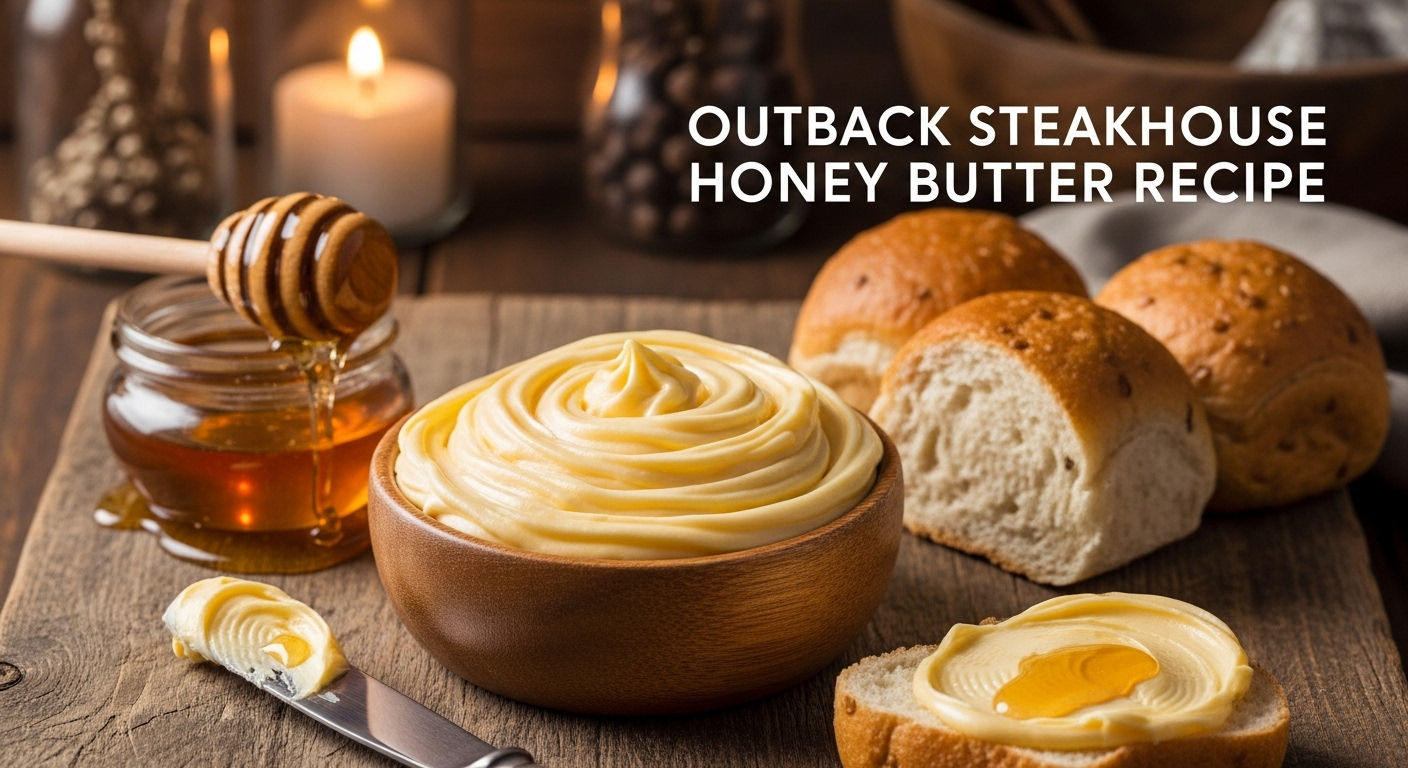
The Steakhouse Style Honey Butter: How, What, and Why

Outback steakhouse honey butter recipe
Steakhouse honey butter is comfort in a ramekin: warm and shiny, and sweet enough to be decadent and still tastes like genuine butter. Imagine it as a little bread sauce instead of frosting; it must be applied in a thin smooth coat, perfume the table with warm honey and end with a mild pinch of salt. The trick is balance. Enough honey and you sicken; a little and you take the place of asking yourself why you had to go. The proportion between home cooks is approximately two volumes butter that is softened to one volume of honey followed by seasoning. That percentage provides body, gloss and a nice drizzle upon warm bread.
The other reason it works: temperature. Room temp butter (roughly 20-22degC) is the only butter that captures micro air once whipped and transforms hard fat into plush and spreadable butter. Since the butterfat is the source of flavor and the small bubbles are what make the butter lighter, it will feel that the result will be much richer but less heavy than a pure butter. Honey adds something to sweetness. Its invert sugars ensure that the mixture is supple in the refrigerator, and its aroma gives even more flavor, which is absent in white sugar.
Lastly, there is no compromise with salt. Although you may want to use unsalted butter, add a pinch of fines sea salt and taste. The salt pulls the sweetness on board, sets the dairy notes on their feet and shines the honey. On the one hand, when you already have salty bread, leave off a few flakes at the table, and not in the batch. And since you did not request copycat discourse we shall keep firmly to business, not mysteries: plain stuff mixed gently, beaten to a smooth, and then served a trifle warmer than refrigerator cold, with just enough shine to appear as a directive, and spread like one. Prepare a little ramekin on the table beforehand, and observe the people when they are at their ease before dinner is served. It always helps.
Choice of Sweetness, Salt, and Honey
Start by choosing the honey. Light, floral honeys have a delicate taste; more dark ones are caramel or molasses. A light clover or acacia style is a good choice of a neutral background on bread. A darker local blend or wildflower is a better choice to deeper, steakhouse evening mood. In any case, taste the honey undress, and then think of it with butter in it; the mental algebra will prevent you from making it too sweet. To the vast majority of palates, a 2: 1 proportion of butter to honey is moderated. Sliding towards 3:1, when serving the honey butter with pre-sweetened rolls. In the case of lean, rough loaves, head towards 1.5:1 and allow the honey to shine.
Now salt. Salt is not an enemy of dessert, it is flavor enhancer. A dust of fine sea salt folded in at the end, in honey butter, holds the sugar in and brings the dairy up. When you use salted butter, either minimize the amount of salt added or keep it away until you get to the table to sprinkle it on. Flaky salt is pretty and it provides a beautiful first crunch and dissolves. Make your crowd an adventure with a taste, but all it takes is a small pinch of smoked or vanilla salt to make the spread a point of discussion without altering the technique of the base.
Last but not the least, balance is a circle, not a line. Warm one spoonful prepared butter of honey and taste it on plain toast. When it is mushy, squeeze a lemon–yes, lemon–a quarter teaspoonful, and whip once more. The citric acid will not cause it to make it sour; it will just sharpen the edges and pucker the sweetness. When it is tiresome, put in a drop of honey and a grain of salt. When it is flat, it most likely requires temperature but not ingredients: allow it to rest five minutes, then check it again. When your shoulders fall you are there. Take now, and laugh at the first slice disappearing so quickly as you thought it would. It happens.
Whipping, Temperature and Texture
The best honey butter starts prior to the contact with the whisk: warm butter. You would have it soft but cold, about 20-22degC–the surface will give to a finger, but the stick will keep its shape. Cold it will mash, not whip; hot it will form a puddle which will never dry. Cubing, to hasten the softening of butter, a time of five to ten minutes on the counter in Lahore heat is usually sufficient. In case you go too soft, put a bowl in the fridge and allow four minutes and repeat.
Whipping is not about speed as compared to air included. You can use a handheld whisk, an electric mixer or a food processor, but you need to work slow at first to loosen the butter and then move to high to create structure. Pour drizzle temperature honey in slowly so that the emulsion remains stable. Wipe down the bowl frequently; puddles of plain honey form unplanned sweet places. When the honey is gone, beat another thirty seconds to smooth out the texture. When the butter looks satin-glossy and mounds soft peaks on the whisk you are through.
Now texture control. To make it eatable, add one or two tablespoons of room temperature cream and beat it a little. To achieve a more compact, cuttable consistency that can be stacked in heaps, omit the cream and refrigerate the smooth butter until fifteen minutes before serving. And in any case, never taste on a spoon, but on a warm piece of bread, which is what heat reveals, and what balance reveals. In case it is too sweet, pinch of salt and blend ten seconds. In case it is low, add one more teaspoon of honey and whip a little. Most importantly, do not overbeat once mixed, excessive beating ruins the flavor and softens structure. Off the end with a subtle swirl in the ramekin and, should you wish a dramatic flourish, a sprinkling of crystals of flaky salt on the surface. And place it next to hot bread, and the smell will need no convincing. Trust me.
Ingredients, Tools and Smart swaps (Lahore Friendly)
Okay, stock your counter so that it is a five minute ritual, not production, to make honey butter. You need: unsalted butter (or salted, adding salt to taste afterwards), honey that you love to eat with a spoon, fine sea salt and lemon, which is optional but adds brightness. Useful, but optional: vanilla extract, cinnamon, ending with a sprinkle of flaky salt, and a tablespoon or two of cream in case you want a more light texture. Utensils: mixing bowl, whisk or hand mixer, flexible spatula and a ramekin or crock. In case you decide to give jars as a gift, then take small sterilized containers and labels so that you do not forget what you put in it when you see it in the future.
Substitutes to Lahore: in case olive oil is expensive, do not add it to the list of ingredients, honey butter does not require it. To add some depth without vanilla, please add a scrape of citrus zest or a pinch of cardamom. When your honey solidifies during colder months, place the jar in a water bath until it is liquid-like – but never microwave the butter mixture afterwards which will ruin the emulsion. Prefer cultured tang? Substitute the cultured butter or whisk in a teaspoon of yogurt; this gives the spread some finesse but does not make it sour. Want nutty richness? Add a spoon of browned butter, which must be allowed to cool to room temperature.
Scaling: 100g butter and 50g honey, make one ramekin in a small household. 225 g butter and 110-120 g honey will make one generous serving to a table of weekend company. Always to remember to taste with bread and not a spoon before having the batch transferred to serving dishes. When the sweetness is high, a pinch of salt will fix much more than you would imagine. Should it be timid, another teaspoonful of honey will generally bring back lustre. Store additional extras in a crock lid and fill the table ramekin with additional resources when necessary. Honey butter is a generous kind, forgetting to leave it out in time is the only actual mistake. Bread should always be taken warm. Truly.
(Optional Add Ins) Cinnamon, Vanilla, Citrus, Cocoa, Smoked Notes
Add ins are not mandatory but they are also the way you make honey butter feel like it was made just for you. The traditional is cinnamon: begin with one eighth teaspoon of 100 g of butter and slowly increase until it smells to the woods. Vanilla is used to give it a roundness, one eighth teaspoon extract to 100 g butter is sufficient. To make a citrus spark, finely grate a strip of orange or lemon zest to the bowl in such a way that the oils drip into the fat. Cardamom speaks of class and it goes well with black tea and scones.
Need a steakhouse night? Add a sprinkle of smoked salt as a finishing touch and add a pinch of smoked paprika (the smallest pieces). Craving campfire sweetness? Separate the maple syrup with a teaspoon and add the honey, and add one pinch more salt to maintain the balance. In a brunch buffet add poppy or sesame seeds toasted to add a soft crunch and a nutty flavor- amazingly well with warm bagels. Dessert lane? In a cocoa kissed one, the amount of unsweetened cocoa used is 1 teaspoon per 100 g butter with a little more honey added.
Experiments are tasty, kept down by a couple guardrails. To start with, to add spices after bringing the base to smooth peaks you are over beating and adding gritty ingredients, which can coarse the texture. Second, keep moisture scarce. Extracts and juices larger than small drops may slack the framework and cause the spread to leak in the refrigerator. Third, not on a spoon, but on a warm bread, because it will show whether the spice is perfuming or pushing. And lastly have one simple lot on the table with the adventurous. People love choice, and, to be honest, so will you, when that one friend falls in love with the orange vanilla type, and requests, sheepishly, another ramekin to take home. Write the flavor and the date on the labels; future you will be glad present you on the occasion when breakfast time comes and you are hungry and in a hurry and all night long with your friends have noise and laughs and talk. Trust me.
Storage, Safety and Make Ahead
In brief: honey butter is easy to store, only it is worth giving some attention to it. Store it in a crock or jar with its lid. Serve at room temperature, not more than a few hours later, refrigerate to maintain quality and food safety. It lasts in the fridge one or two weeks, depending on its moisture, salt, and your fridge habits–clean spoons have longer lives. To store longer, scoop into small containers and freeze, not more than three months; thaw overnight in the fridge, and then allow to relax on the counter again before it is spreadable.
Safety notes are simple. Butter and honey are considered both low risk foods though cross contamination is a fact. Always rinse under water and never put back the ramekins that have not been used back in the mother jar. Should you incorporate anything other than butter–e.g. cream or yogurt–then manipulate the mixture as a fresh dairy spread and store it in the refrigerator. When your kitchen overheats, only the stuff that you are likely to use within an hour should be placed out, and replenished accordingly. The aim is hedonism without any concern rather than a scientific experiment on the table.
Make ahead is your friend. A day prior to arrival of guests whip a large mix and divide it into two ramekins one in the kitchen, the other in the table. Hold the reserve in ice; replace it as soon as the first one goes past its prime. To be fancy, pipe butter into the ramekin using the star tip followed by a few seconds of refrigeration to form ridges. Serve with flake-salt sprinkled on it or a piece of honey. And a very small, sincere admission, I forget to take it out early occasionally. In case that occurs, cut a fat coin, lay it on hot bread and just pretend it was all intentional. Who cares what the story is, everybody will be interested in the melt, and who knows, you will get all the credit in recalling dessert napkins, which actually is nearly about as important as butter.
Make It Tonight (2 easy techniques + serving moves)
This is your no drama route in refrigerator to table.
Method one: hand whisk. Blot 225g unsalted butter and allow it to soften till a thumb creates a slight mark. Whisk in a large bowl until creamy and a little bit lighter. While whisking, drizzle in 110-120 g room temp honey and scrape the bowl to ensure nothing is covering up. Sprinkle in a little fine sea salt and shake an additional thirty seconds until satin glossy. Taste on warm bread. When sweetness is forward put in three grains of salt. In case it is coy, add one teaspoon more of honey. Pour into a ramekin and swirl the surface and the curves should be set by chilling five to ten minutes.
Method Two: mixer or processor. Add softened butter in a stand mixer with the paddle and beat on medium until it is smooth and somewhat aerated one or two minutes. As the machine is running low add in honey; turn up to medium and beat an additional thirty seconds. To be lighter add one to two tablespoons room temp cream and beat in. To make a denser, cuttable mound, do not add the cream and chill the completed butter a few minutes. Taste lightly warm bread, and add salt or honey, without a clout.
Serving moves. Take the ramekin out ten minutes prior to bread appearing on the table so that it is spreadable. You can add some flaky crystals or thread of honey at the finish, when you want shine. Serve with warm, brown bread, soft dinner-rolls, biscuits, cornbread, pancakes, grilled corn, or roasted carrots; where the sweetness of it balances so nicely with savory borders. Keep the backup ramekin on ice, and replace it when the first ramekin is almost drained. Should anybody require the recipe, smile and tell them, soft butter and good honey and a light hand. Then bring up your glass–success is better with company. and should a smear come upon the napkin, laugh; and this was the end of this spread always joy. Really.
Method: This method is used when the quantity of product is low, typically a small amount of food, and the final outcome must be precise. When the amount of product is minimal, usually a small amount of food, and the end result should be accurate this is when the Method is used.
The best thing about hand whisking is that it is old fashioned, silent, rhythmic, strangely relaxing. Begin with 225g of unsalted butter in cubes. Allow it to become soft so that your finger can make a tender depression and the cube does not lose its shape. Place the butter in a broad bowl; you have that extra surface area in which to whisk, which is so much better on your wrist. Take a balloon whisk, and start in a slow way, scraping butter against the sides until it appears creamy and a bit paler. Add 110-120g drizzle room temperature honey in a thin thread, and whisk continuously. Stop to scarp the bowl; pieces of unwhitened butter are obstinate afterwards.
Add a small pinch of fine sea salt and then whisk an additional thirty seconds to remove the remaining streaks. You want satin shine and smooth mountains that are suspended a minute upon the whisk and then drop. On warm Bread, Taste not a spoon. When it is sweet, add a few grains of salt and shake ten seconds. Should it come out shy, then add another teaspoon of honey and whisk until it is mixed. Pour into a ramekin and swirl the top and refrigerate five minutes to set. And add some flaky crystals should you feel the need of a touch of glitter.
A few practical tips. When your kitchen is hot, put the empty mixing bowl in the freezer two minutes prior to starting, a cool bowl maintains structure vivacious. When your wrists get tired, use a flexible dough whisk, it has an open pattern, which takes the thick mixtures easily. In case you go too soft, and the butter becomes sloppy, refrigerate the bowl four minutes, then whisk it a minute or two to give its sheen back. And when a drop of honey drops down the ramekin clean it with a towel and declare it rustic. It is not perfection it is deliciousness–and you, my friend, are already very close. Snort, dry, eat, breathe; the time passes by the minute relaxed.
Batch/Consistency Based Method (Mixer/Food Processor Method)
A stand mixer or food processor substitutes romance with reliability which is ideal when you are cooking a whole crowd or multitasking a meal. Install the mixer with the paddle, or the processor with the metal blade. Add 225 g softened unsalted butter drop in and beat on medium (or pulse in short bursts), until smooth and slightly aerated, one to two minutes. When the machine is running on low, pour in 110-120 g room temperature honey. Add to medium and proceed thirty seconds; you are in pursuit of a satin gloss and smooth and lazy peaks.
To achieve a lighter and almost cloudlike spread, 1-2 tbsp room temp cream may also be added and beaten a little to blend. To make a more dense mound that can be sliced, omit the cream, and then refrigerate the completed butter five to ten minutes to chill it. This is because it is better to stop the machine and scrape the bowl and processors are particularly fond of concealing streaks under the blade. Taste on warm bread. Provided it has a sweet taste, then add a pinch of fine sea salt and beat ten seconds. Should it say shy, trickle in another teaspoonful of honey and beat just until homogenous.
Machines excel in Batching. Increase it by 2 or 3 times in a large bowl, pour into small rameins, and refrigerate, recapped. Drag one and leave service jostling. To give as gifts, pour into little jars, flatten the lids and stick on a small label: hone butter, date, love. Should you desire restaurant style swirls, pour into a piping bag fitted with a star tip and quickly draw concentric circles in each ramekin and then chill them. And bear in mind, machines are noisie, and you have to have your tasting bread onboard, in order to correct taste without missing a beat. Then, when you do finally put the ramekins down, wait a moment. Such a smooth and shiny swirl is food-time hospitality you can feel, and your table will be feeling it before the first bite of the food is deposited upon it.
FAQs
Is it possible to use salted butter in place of unsalted in Honey butter?
You can–but be sparse with placing an addition of salt. When your rolls or bread is already salty, sprinkle a little flaky salt on the table rather than add too much of it to the batch.
What is the best way to preserve my butter of honey soft and easy to spread?
The secret is room temperature butter (approximately 20-22degC). Whipped butter, by reason of being whipped, traps air and becomes light and fluffy. Honey is also added to maintain smoothness of the mix and avoids hardening of the mixture in the fridge.
What is the shelf life of homemade Honey Butter?
Honey butter can be kept at the fridge up to 1-2 weeks provided you use clean utensils. To long store, freeze in jars that are small within a period of up to 3 months- just thaw out overnight in the fridge and serve.
What kind of honey is best in this dish?
Light clover or acacia honey is gentle with sweetness whereas darker wildflower or local mixtures have a deep and caramel taste. Select according to the type of bright daytime spread you desire or the more luxurious, steakhouse atmosphere.
Is it possible to flavour honey butter with such flavours as cinnamon or vanilla?
Absolutely! Even plain honey butter is made memorable with cinnamon, vanilla, citrus zest or just the slightest pinch of smoked salt. Simply add the extras in very small amounts to avoid the butter becoming greasy and lopsided.
